Since the launch of Roundup Ready Xtend soybeans we have observed great success in terms of weed control. The use of approved dicamba formulations in soybeans adds another tool to the weed management tool belt to manage tough-to-control weeds such as waterhemp and marestail. February 6th of this year Engenia®, Stryax™ and Tavium® were all approved by the United States Environmental Agency (EPA) for two years of use and with those labels came new label application requirements.
- Dicamba-containing products for use in soybeans have approval for in-crop use as an additional tool in the weed management toolbox for tough to control, herbicide resistant weeds.
- Spraying small weeds with the proper adjuvants, nozzles and carrier volume will provide the greatest level of efficacy on our hard-to-control weed species.
- Follow all federal and state approved labels to ensure applications are made according to appropriate guidelines.
- An integrated weed management approach is still needed to successfully manage our hard-to-control and resistant weed species.
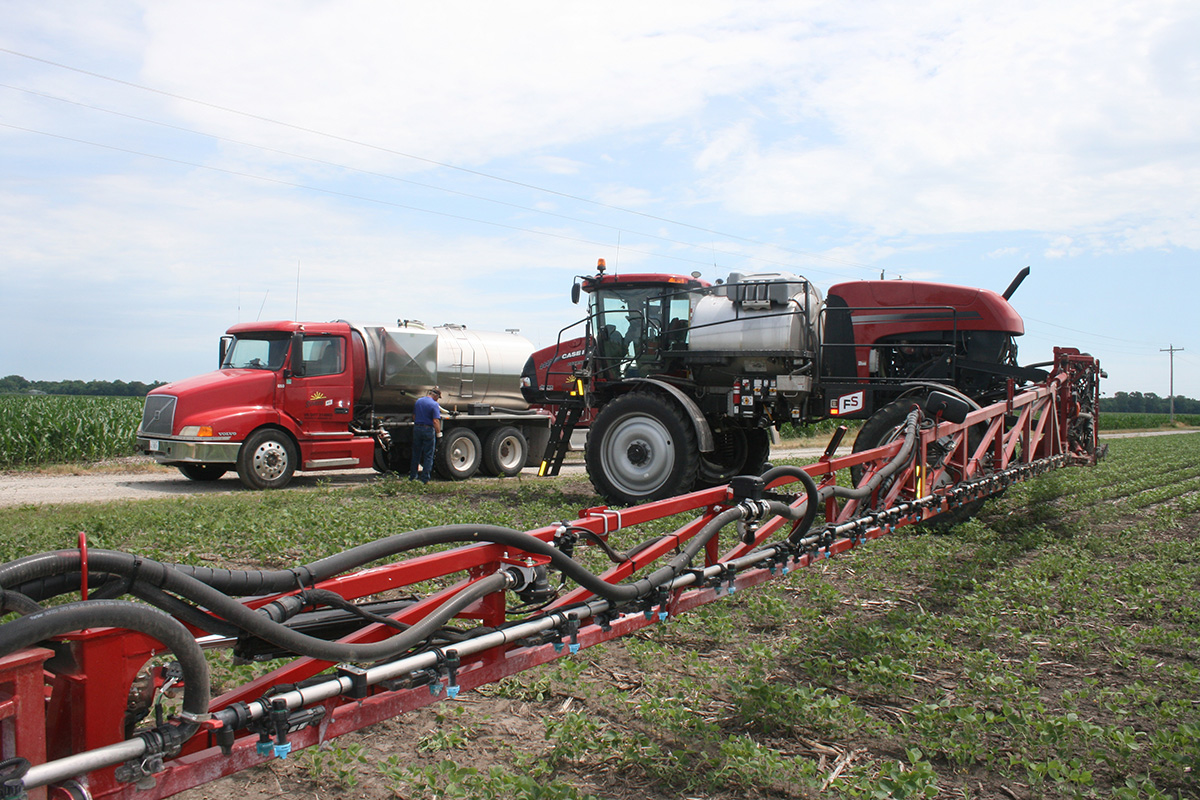
Since the launch of Roundup Ready Xtend soybeans we have observed great success in terms of weed control. The use of approved dicamba formulations in soybeans adds another tool to the weed management tool belt to manage tough-to-control weeds such as waterhemp and marestail. February 6th of this year Engenia®, Stryax™ and Tavium® were all approved by the United States Environmental Agency (EPA) for two years of use and with those labels came new label application requirements. To steward this technology, it’s imperative that applications are optimized to their fullest potential so maximum weed control is possible. The following best management practices below are from the federal labels for Engenia®, Stryax™, and Tavium® in XtendFlex® soybeans. Remember to also check for state approved labels for any additional restrictions to ensure applications are being made according to federal and state labels.
Best Management Practices
Nozzles and Carrier Volume
Nozzle selection can be an emotional and daunting task, factors that go into selecting the correct nozzle are droplet spectrum, desired application speed, pressure and gallons per acre, and sprayer system (Pulse Width Modulation versus standard). The new labels do not have an official approved list of nozzles, however, labels require the use of nozzles that produce coarse volume median diameter (VMD) or larger droplet sizes. For additional drift mitigation ultra-coarse droplets can be used to lessen the potential for off-target movement to sensitive vegetation. Ultra-coarse size droplets will reduce overall coverage, therefore, increasing the carrier volume may be needed to contribute to greater efficacy of tough-to-control weeds along with volunteer corn. The lack of volunteer corn control in the past was likely due to poor coverage in scenarios where clumps of plants existed. Increasing the carrier volume will result in more droplets covering those clumps which reduces the chance for escapes.
Adjuvants
Adjuvants are in integral part of any postemergence herbicide application, without the proper adjuvant, efficacy is often compromised. With application of any three approved dicamba formulations, an oil emulsion drift reduction adjuvant (DRA), and a volatility reduction adjuvant (VRA) are required, however, do not forget about water conditioning adjuvants. FS Layout™ 2.0 is an oil emulsion DRA, FS Cogent™ and FS Argent™ also contain an oil emulsion DRA that would satisfy the DRA need. The DRA rate needs to be used at 0.3% volume-to volume (v/v) of final spray solution. The second need in all applications is a volatility reduction adjuvant (VRA) at 40 oz/A. FS Dissension™ is a qualified VRA that should be used in all applications. Most of the water used for applications contains hard water cations like calcium, magnesium and iron which tie up weak acid herbicides like dicamba, often rendering the herbicide less effective. Water conditioning adjuvants on the market that do not contain ammonium sulfate (FS Certin™) should be added to the tank to mitigate hard water tie up of the herbicide so that weed control isn’t compromised. Should an oil adjuvant like a COC or MSO be necessary with a tank mix partner, FS Cogent™ and FS Argent™ can be used, and they would satisfy the DRA requirement as well.
Temperature, Growth Stage Cutoff & Endangered Species Act (ESA) Mitigations
Applications of Engenia® or Stryax™ may be made to dicamba tolerant soybeans through the R1 growth stage (1st flower), and Tavium® may be made through the V4 growth stage (4 fully expanded trifoliates). Remember to check for additional state labels that may restrict these guidelines further. All federal labels have temperature ranges where additional application parameters exist, however, some states have restricted temperature further. Federal guidelines require the applicator to only apply 50% of dicamba tolerant (DT) soybean acres managed by a grower within the county to be sprayed if the temperatures are above 85F and less than 95F. For example, if a grower has 500 acres of DT soybeans and the temperature is forecasted to be 90F for the day of application only 250 of those acres can be sprayed on that day OR the following day. Application to those acres can be made on the 3rd day after the initial application. If temperatures are forecasted to be above 95F, no applications can be made. Applications must follow the Endangered Species Act requirements for runoff and erosion mitigation, and spray drift mitigation. All applications will require 3 runoff and erosion mitigation points if the field is not in a Pesticide Use Limitation Area (PULA), and 6 runoff and erosion mitigation points if the field is in a PULA. Check Bulletins Live! Two to verify if the field(s) being sprayed are in a PULA prior to any application. If a sensitive crop is not downwind, a downwind buffer of 240-feet is required to satisfy the spray drift buffer component of the ESA mitigation. Reductions in the spray buffer distance are possible by following approved drift mitigation practices on the label along with information regarding runoff and erosion mitigation points by visiting the link here. Remember to keep all records either on paper or digitally for all applications.
Final considerations
While many have experienced the benefits of the Xtend system, we cannot forget that the success of this technology relies on a program approach. To manage weeds in the short and long term, we must utilize preemergence herbicides because without one, management is likely to fail. When it comes to the POST emergence applications, include an overlapping residual to manage weeds through the establishment of the crop canopy. When we take this chemical approach, along with cultural and mechanical control measures, we can start clean and stay clean throughout the season.
With planting right around the corner, the 2026 crop should be going in the ground. We need to think about the best management practices such as the ones outlined above and make sure to capitalize on those as part of a total weed management plan. Contact your local FS Crop Specialist with any questions regarding dicamba application best management practices or to purchase dicamba-tolerant soybeans.