Are you using the right spray adjuvants to enhance pesticide performance, improve coverage and penetration, reduce environmental risks, ensure product compatibility, and support regulatory compliance in sustainable agriculture?
- Adjuvants improve pesticide performance by modifying the spray pattern, droplet, deposit properties (spray quality), and rate of movement of the pesticide into the plant (uptake and penetration).
- Not all adjuvants are the same. For example, water conditioners have a different role than surfactants or crop oils. Consult the herbicide label to see which adjuvants are required for each product. Some pesticides may require more than 1 adjuvant.
- Choosing an adjuvant for a tank mix (2 or more herbicides or pesticides) can be complicated. Consult the label of each product to determine the best choice.
The purpose of this article is to briefly describe the main spray adjuvant categories used in agricultural applications. Specific references to Growmark products in each category will be made in these descriptions.

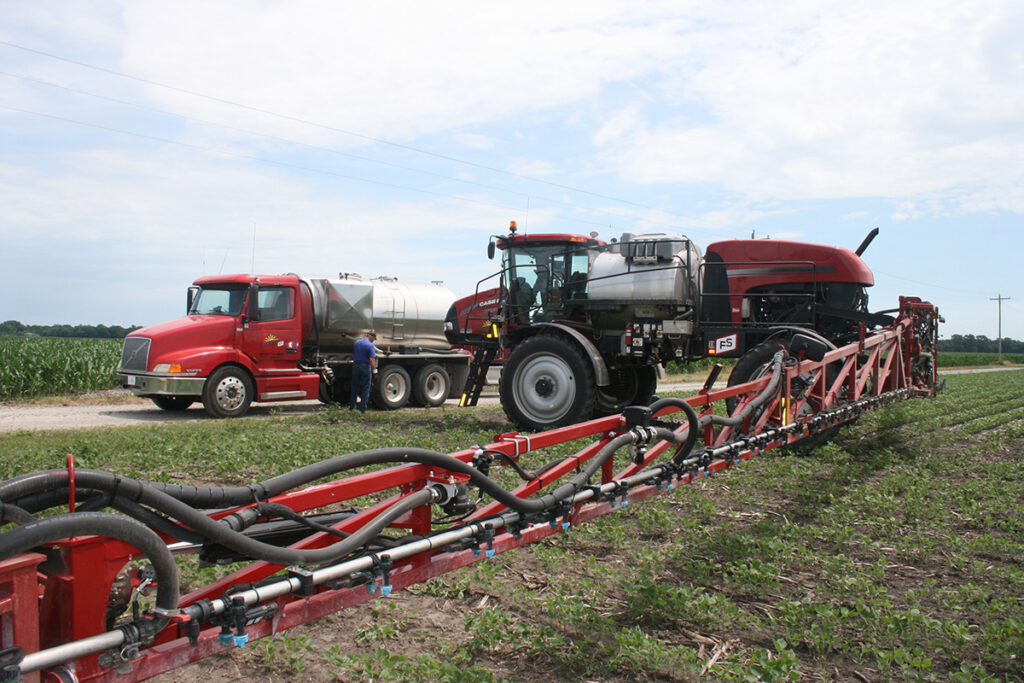
Image source – https://www.deere.com/en/sprayers/400-600-series/power-efficiency/
Water Conditioning Agents
Water conditioning agents (or water conditioners) are adjuvants that bond with dissolved hard water cations such as potassium, sodium, iron, magnesium and calcium. They provide “sacrificial” molecules to keep pesticide molecules from bonding to the hard water cations. In chemistry, this process is called chelation. Tying up these minerals allows the weed to more readily absorb the pesticide.
The most common water conditioning agents are spray grade ammonium sulfate (AMS) or liquid product such as such FS MaxSupreme™ (AMS and drift reduction), FS AMS LDF TM (AMS, defoamer), FS Certin™ (non-AMS water conditioner), and FS Intention ™ DVA (non-AMS water conditioner, drift reduction, volatility reduction).
Surfactants
Surfactants (also called wetter-spreaders) are adjuvants that lower the surface tension of spray droplets. This allows gravity to collapse and flatten the spray droplet to the leaf surface, which in turn allows droplets to spread over a larger area. Surfactants can also reduce the amount of bounce a droplet will experience when it hits a leaf (deposition aid). However, NIS is typically less aggressive in penetrating the leaf than adjuvants that contain oil, which will be discussed below.
The surfactant adjuvants most commonly tank-mixed with pesticides are called nonionic surfactants (NIS). These surfactants are often made with materials that have an affinity for waxy plant surfaces.
Organosilicones are a type of NIS that are commonly used as tank-mix adjuvants with pesticides. Organosilicones are often called super-spreaders or super-wetters because they decrease surface tension so much. They also may have penetrant properties (activator or sticker). Organosilicones greatly increase droplet spreading and decrease droplet sizes, which may be more desirable for some active ingredients and application conditions and less desirable for others.
Common FS products in this category include FS AquaSupreme 2.0™ (NIS and activator), FS CropStik™ (NIS), FS AMS MAX 2.0™ (AMS, drift reduction, surfactant), and FS Talent™ (drift reduction, NIS, deposition aid).
Oil Concentrates
Oil concentrates are adjuvants that help pesticides overcome leaf barriers to penetrate leaves better. They work because oily components soften or disrupt the waxes on leaf surfaces.
There are three general groups of oil concentrate adjuvants (based on their ingredients): crop oil concentrates, modified (methylated) seed oils, and high-surfactant oil concentrates.
Crop Oil Concentrates (COCs) and High-Surfactant Oil Concentrates (HSOCs)
Crop oil concentrates (COCs) are adjuvants that contain petroleum-based oils. Most crop oil products today are either methylated seed oils (MSO), high surfactant oil concentrates (HSOC), or high surfactant methylated seed oils (HSMSO).
High-surfactant oil concentrates (HSOC) are adjuvants that were initially developed to improve control at lower use rates than COCs and MSOs. HSOCs also were developed to address the changing needs of tank mixes that contain glyphosate and are being applied to manage herbicide-resistant weeds.
Premium HSOC products may contain 20 to 40 percent NIS with 60 to 80 percent of the specific type of oil. These ingredients generally form more stable spray emulsions and may reduce use rates compared to comparable COC formulations that contain lower levels of surfactant. FS COC Supreme TM (HSOC) and FS Cogent TM (HSOC, drift control, and deposition aid) are products in this category.
Methylated Seed Oils (MSOs) and High-Surfactant Methylated Oil Concentrates (HSMOCs)
Methylated seed oils (MSOs) are adjuvants that are derived from plant seed oils. Soybean oil is the most common MSO, although other oils can be used (such as canola, cotton, and sunflower). MSOs frequently contain 50 to 90 percent oil, enabling them to soften or break down waxes in the leaf cuticle.
The nonoil components of these adjuvants are usually surfactants. MSOs typically do not perform as well as surfactants at spreading when formulated at very high oil rates. Manufacturers add more surfactants to these adjuvants to enhance wetting or spreading and to improve performance for water-soluble pesticides.
Like HSOC’s, HSMOCs are adjuvants that were initially developed to improve control at lower use rates than COCs and MSOs. However, HSMOC’s have the added benefits of containing a methylated seed oil as the oil component, which provides better penetration of the plant cuticle. FS OptivixTM (HSMOC), and FS Argent TM (HSMOC, drift control, deposition aid) are products in this category.
Compatibility Agents
Compatibility agents are adjuvants that help incompatible products work together. They are most often used in complex tank mixtures that may include multiple crop protection products using fertilizer solution carrier systems. Always check product labels for information about the compatibility of spray materials before adding them to a spray mixture. Compatibility might be particularly problematic when the application has a high concentration of dissolved fertilizer, water conditioners, or micronutrients. Ammonium Thiosulfate (ATS) solutions can have compatibility problems when used with some herbicides during cool spring application seasons and benefit greatly from the addition of a compatibility agent such as FS TankmaxTM. Even with a compatibility agent, it is critical to add each product to the spray tank or inductor in the proper order.
pH Adjusters
The pH adjusters (also called acidifiers and buffers) are adjuvants that maintain or prolong a pesticide’s stability by modifying the spray solution’s final pH. Most pH adjusters are acidifiers that lower pH. Adjuvants that raise pH are less common.
Drift Reduction Agents
Drift reduction agents (deposition and retention aids) are adjuvants that help limit the drift of pesticide sprays off target. There are many different types of these products, so some function better in certain nozzles than others.
Some of these adjuvants thicken (build viscosity) in the solution to change the way spray droplets are formed. Some of the polymers that thicken the solution also help improve retention on the target by reducing the chance that droplets will bounce, shatter, or run off. However, polymers may also increase incompatibility issues. For example, they may not work well with certain drift reducing nozzles, producing a poor spray pattern or very large droplets that may affect pesticide performance.
Drift suppressing agents may provide other adjuvant functions, such as improved retention and spreading of droplets. Depending on their composition, these adjuvants may also help to improve foliar uptake.
In the FS product lineup, there simple drift mitigation products, and there are premixes that have a drift reduction agent and other surfactants as well. The simple drift mitigation products are FS Intention TM (drift reduction and deposition aid) and FS Layout 2.0 TM (drift reduction and deposition aid). The drift reduction premixes include FS Max Supreme TM (AMS and drift reduction), and oil emulsion drift reduction agents are included in the FS Talent TM, FS Cogent TM, and FS Argent TM products as well.
Volatility Reduction Agents
Volatility Reduction Agents (VRA’s) contain products that reduce the formation of the volatile forms of herbicides like dicamba that can move off-site as a gas. FS Intention TM (non-AMS water conditioner, volatility reduction) and FS Intention DVA TM (non-AMS water conditioner, drift reduction, volatility reduction) are volatility reduction agents. Pay close attention to the new dicamba soybean labels since they require higher rates of volatility agents. The FS Intention DVA product label doesn’t allow a high enough rate to be used with the new dicamba products in soybean. But it could be used for the dicamba products used in other crops like corn and grass pastures.
Multi component tank mixtures are required to control the broad spectrum of weeds in our agronomic crops. It is imperative to get the maximum efficacy from each herbicide in the tank to protect crop yields. High quality adjuvants are needed to ensure that the product is deposited on the target plant and that the weed is able to absorb the herbicide. Contact your FS Crop Specialist for help in picking the correct adjuvants for your weed control program.