Excessive spring rainfall and resulting soil saturation are common challenges in Midwest soybean systems. While the visible concerns are often stand establishment and root health, a less obvious—but equally critical—impact is on the survival and function of Bradyrhizobium japonicum, the bacteria responsible for nitrogen fixation in soybeans.
- If spring rains have left fields saturated, it is time to consider using a rhizobia inoculant.
- Saturated field conditions reduce rhizobia activity and nodulation success.
- Rhizobia inoculation provides a strategy to restore nitrogen-fixing capacity, improve nodulation consistency, and protect yield potential.
Excessive spring rainfall and resulting soil saturation are common challenges in Midwest soybean systems. While the visible concerns are often stand establishment and root health, a less obvious—but equally critical—impact is on the survival and function of Bradyrhizobium japonicum, the bacteria responsible for nitrogen fixation in soybeans (figure 1).
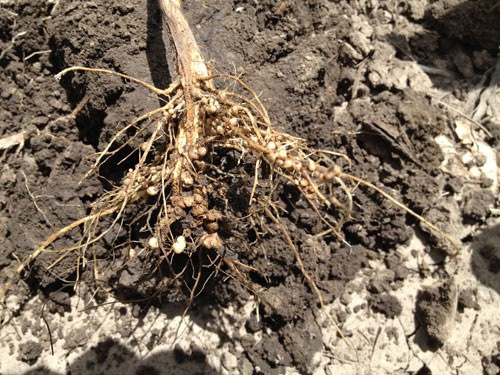
Research and field observations suggest that 3–7 days of saturation can begin to reduce rhizobia activity, while 7+ days may significantly reduce viable populations. Without adequate oxygen, Rhizobia survival and metabolic activity reduces, leading to delayed or failed infection of soybean roots as well as abortion or inactivity of early nodules.
Using an inoculant like biotrinsic M34+N13 is especially important in fields that have been saturated for 3+ days where rhizobia density may be below the threshold needed for consistent nodulation. Ponded or poorly drained areas often experience greater rhizobia loss, leading to uneven nodulation across the field. In these scenarios, applying a rhizobia inoculant helps reintroduce a high concentration of viable bacteria at the seed zone, improving the probability of timely and effective nodulation.
Inoculation is particularly justified under the following conditions:
- Prolonged soil saturation (≥3–7 days)
- Fields with poor drainage or frequent ponding
- Cool, wet springs delaying root development
- Fields with extended corn rotation or no recent soybean history
- Early planting into marginal soil conditions
While many Midwest soils contain established rhizobia populations, spring saturation can significantly reduce their effectiveness during the critical nodulation window. In these conditions, rhizobia inoculation provides a targeted, cost-effective strategy to restore nitrogen-fixing capacity, improve nodulation consistency, and protect yield potential.